

Static Electricity in Warehousing & Logistics
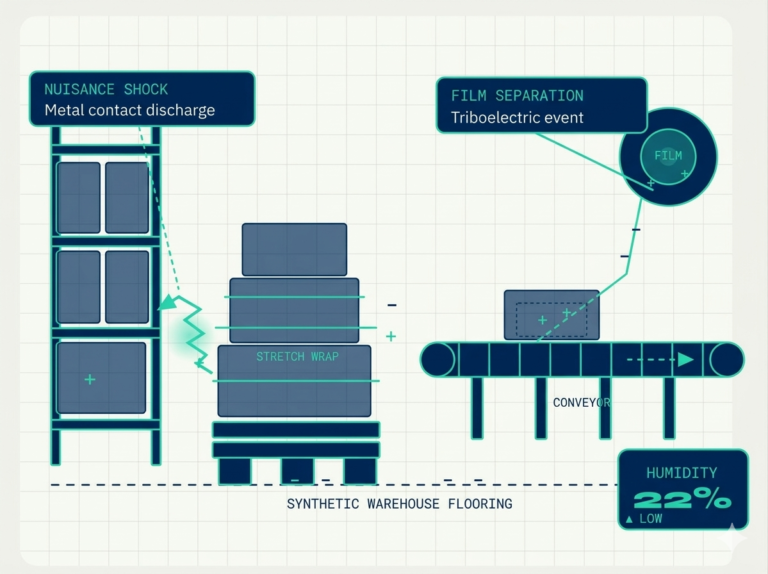
Warehouses and logistics facilities combine many of the conditions that allow static electricity to develop and persist. Large insulated surfaces, constant movement of packaging materials, synthetic flooring, and dry indoor air can all contribute to electrostatic charge build-up.
In Australia’s often dry climate, static electricity can appear during normal warehouse operations such as product handling, pallet movement, packaging processes, and conveyor transport. Understanding how static forms in these environments helps explain common issues such as nuisance shocks, dust attraction, and packaging interference.
FUNDAMENTALS
Why Static Electricity Occurs in Warehousing & Logistics
Warehousing and logistics operations bring together insulative materials, large dry indoor spaces, and continuous physical movement, a combination that creates persistent conditions for electrostatic charge generation and accumulation.
Material Behaviour
Many materials used in logistics and storage environments are electrically insulating. When they contact and separate from each other, electrons transfer between surfaces, and because insulating materials do not allow charge to dissipate easily, static electricity can accumulate over time.
- Plastic packaging films and wraps
- Cardboard cartons and corrugated boxes
- Polypropylene strapping and pallet wraps
- Synthetic pallet covers and liners
- Plastic storage bins and containers
Environmental Contributors
Warehouse environments often amplify static electricity due to their size and environmental conditions. When humidity is low, surfaces become less conductive, allowing electrostatic charge to remain on materials and equipment longer.
- Low humidity levels inside large buildings
- Air conditioning or ventilation systems
- Dry winter conditions across Australian regions
- Dust and airborne particles in circulation
- Large insulated floor areas with limited dissipation
Handling and Friction Factors
Normal warehouse operations generate static electricity continuously through the triboelectric effect, particularly when insulating materials interact with each other during everyday tasks.
- Walking across synthetic flooring
- Moving cartons along conveyor belts
- Sliding plastic packaging across work surfaces
- Stretch-wrapping and unwrapping pallets
- Handling plastic containers and bins
Charge Generation Sequence - Composites Fabrication
Surface Contact
Packaging material contacts another surface
Electron Transfer
Film peel, carton lift, or pallet movement
Separation Event
Low humidity prevents natural dissipation
Charge Retained
Insulative material retains surface charge
Discharge or Attraction
Shock, film cling, or dust attraction
RISK ASSESSMENT
Risks Associated With Static in Warehousing & Logistics
Static electricity in warehouse and logistics environments creates a range of operational and personnel concerns, many of which vary with seasonal and environmental conditions, making them appear difficult to predict.
Safety Concerns
Static discharges in warehouses are typically small but can produce sudden shocks when workers touch grounded metal objects such as shelving, forklifts, or equipment. While usually harmless, they can cause surprise reactions or discomfort during routine work.
- Spark ignition risk near flammable solvents
- Operator shock or startle during film removal
- Nuisance discharges reducing operator confidence
- Increased risk in enclosed or poorly ventilated areas
Operational and Productivity Impact
Static electricity can affect logistics operations in several ways. These issues often vary depending on environmental conditions, making them appear unpredictable.
- Packaging materials sticking together
- Plastic films clinging to products or surfaces
- Difficulty separating packaging layers
- Conveyor movement disruptions
- Increased handling time and rework
Contamination and Surface Defects
Electrostatic charge on packaging materials can attract airborne dust and fibres, creating additional operational and hygiene challenges in warehouse environments.
- Increased cleaning requirements on packaging lines
- Contamination of packaged goods
- Dust accumulation on plastic containers or films
- Particle attraction in open-air or high-traffic areas
COMMON MISCONSEPTIONS
Myth vs Reality in Warehousing
Two widely-held assumptions about static electricity are particularly relevant in warehouse and logistics settings, and both can lead to ineffective approaches to managing electrostatic issues.
Grounding metal equipment eliminates the static problem
Grounding metal equipment or warehouse structures is important for electrical safety, but it does not eliminate static electricity generated on insulating materials such as plastics or packaging films. Because these materials do not easily conduct electricity, charge can remain on their surfaces even when surrounding structures are grounded.
Static electricity only matters in electronics environments
Static electricity is often associated exclusively with electronics manufacturing. However, static behaviour affects many materials commonly used in logistics environments, including packaging plastics, films, and synthetic surfaces, regardless of whether any electronic components are present.
Charge on insulating surfaces requires different management approaches
Insulative materials such as plastic films and cardboard cannot be discharged simply by grounding nearby metalwork. The charge resides on the material surface and requires approaches suited to the properties of insulating materials to achieve meaningful dissipation.
Warehouses exhibit the same underlying charge physics as any industry
Understanding this broader behaviour helps explain why static problems appear in warehouses, packaging cling, persistent shocks, dust attraction, even when no sensitive electronics are present. The triboelectric effect operates the same way regardless of industry context; only the materials and consequences differ.
FRAMEWORK
General Categories of Static Control Approaches
Static control in warehousing and logistics environments is organised around three broad conceptual categories. Each must be evaluated in the context of specific operational conditions, materials handled, facility layout, seasonal humidity patterns, and the nature of the problems observed.
01 / Environmental Control
Humidity and Airflow Awareness
Environmental factors strongly influence electrostatic behaviour in warehouses. Humidity is among the most significant, as ambient moisture increases, the surface resistivity of many insulative materials decreases, facilitating passive charge dissipation.
- Humidity awareness and monitoring
- Ventilation and airflow management
- Dust control strategies
- Temperature and seasonal pattern awareness
02 / Surface Treatment Concepts
Material and Surface Approaches
Some environments apply surface treatments that influence how materials interact with electrostatic charge. These may range from temporary treatments to longer-term approaches depending on operational requirements. Their effectiveness depends on material compatibility, environmental conditions, and maintenance practices.
Understanding the triboelectric characteristics of packaging and flooring materials in contact with one another provides the conceptual basis for evaluating surface-based approaches.
03 / Handling & Process Awareness
Workstation Design and Workflow
Warehouse operations themselves often generate static electricity. Understanding how charge develops during everyday logistics activities can help reduce recurring issues before supplementary interventions are introduced.
- Packaging material selection
- Conveyor system behaviour and surface types
- Workstation layout and material flow
- Handling procedures for high-charge materials
Charge Generation Sequence
Step 01
Assessment
Step 02
Strategy
Step 03
Implementation
Step 04
Monitoring
ANALYTICAL APPROACH
Understanding the Problem Before Acting
Static electricity in warehouse environments often varies depending on materials, environmental conditions, and operational movement. Because of this variability, effective static management usually begins with understanding the conditions that generate electrostatic charge, before selecting any control approach.
Observation and measurement across seasonal periods is particularly valuable in Australian warehousing contexts, where humidity can shift substantially between summer and winter operational conditions.
Environmental Measurement
Humidity and temperature profiling across warehouse zones, including storage areas, packing stations, and high-traffic operational corridors.
Material Identification
Characterisation of all insulative materials involved in packaging, handling, and storage workflows, including films, wraps, containers, and flooring.
Process Observation
Recording which logistics operations produce observable charge events, conveyor runs, film removal, stretch wrap application, forklift movement, and at what frequency.
Facility and Layout Review
Mapping when static problems are most frequently reported, often aligning with low-humidity winter periods or high-throughput seasonal operational peaks.
STATIC PROFILE DIAGNOSTIC FRAMEWORK
Environment
Humidity, temperature, season, airflow
Material
Board type, coatings, conductivity
Behaviour
Shock frequency, location, user patterns
Hygrometer
Surface Material ID
Human Interaction
Each variable must be independently characterised before a meaningful risk profile can be constructed for a warehousing or logistics facility.
About Zero Static
Understanding Static Electricity Across Australian Industry
Zero Static helps Australian industries understand how static electricity behaves across materials and environments. Our focus is on providing technically grounded, evidence-based information that supports informed decision-making, without prescribing specific products or solutions.
The Warehouse & Logistics industry page is part of a broader knowledge resource covering static behaviour across manufacturing, fabrication, and infrastructure environments throughout Australia..
Explore the full authority knowledge base here