

Static Electricity in Composites
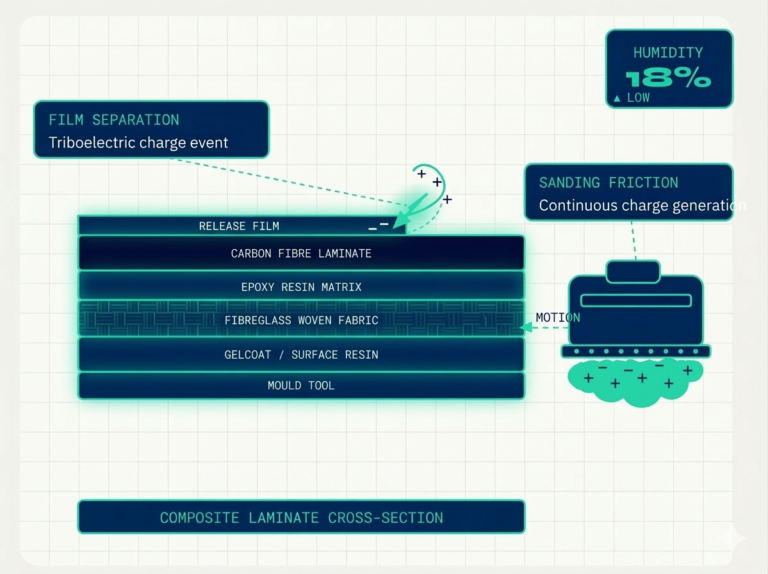
Composite fabrication environments are characterised by the continuous contact and separation of highly insulative materials, fibreglass, carbon fibre, epoxy resins, and polymer coatings, that rank among the most electrostatically active substances in the triboelectric series. Every stage of the fabrication process, from layup and moulding to sanding and surface finishing, creates conditions in which significant charge accumulation can occur.
In the dry workshop conditions typical of Australian manufacturing and marine fabrication environments, charge dissipation is limited, making an understanding of static behaviour essential for anyone involved in composite production.
For a broader overview of static behaviour across industries, see here
FUNDAMENTALS
Why Static Electricity Occurs in Composites
Composite fabrication brings together an unusually high concentration of electrostatically active insulating materials, processed through operations, sanding, moulding, laminating, and film removal, that are inherently charge-generating. The workshop conditions common in Australian composite manufacturing compound these material characteristics significantly
Material Behaviour
The base materials used in composite fabrication are predominantly polymeric insulators with limited capacity to dissipate surface charge naturally.
- Fibreglass (GFRP) fabric and matting
- Carbon fibre (CFRP) dry fabric and prepreg
- Epoxy, vinylester, and polyester resins
- Polymer protective and release films
- Vacuum bagging films and breather fabrics
- Foam core materials (PVC, PET, balsa surfaces)
Environmental Contributors
Workshop environments used for composite fabrication frequently present low ambient humidity, particularly across inland and climate-controlled Australian facilities.
- Low relative humidity in enclosed workshops
- Warm, dry conditions during Australian summers
- Dust extraction systems that reduce ambient moisture
- Air movement from ventilation reducing surface charge decay
- Temperature cycling between work sessions
Handling and Friction Factors
The fabrication process involves repeated high-friction contact and separation events between insulating surfaces — each one a potential triboelectric charge generation event.
- Mould release film removal from panel surfaces
- Sanding and grinding of cured laminate
- Handling dry fabric plies during layup
- Movement of vacuum bagging consumables
- Surface cleaning with solvent-dampened cloths
- Manual transport of large panel sections
Charge Generation Sequence - Composites Fabrication
Surface Contact
Insulative composite contacts tool or film
Electron Transfer
Charge migrates across material boundary
Separation Event
Film peel, part release, or sanding action
Charge Retained
Low humidity prevents passive dissipation
Discharge or Attraction
Spark, shock, or dust and fibre contamination
RISK ASSESSMENT
Risks Associated With Static in Composites
Static charge in composite fabrication environments creates risks that span safety, product quality, and process efficiency, and are often attributed to other causes without investigation into electrostatic origins.
Safety Concerns
Composite fabrication environments involve flammable solvents, acetone, styrene, and epoxy thinners, used for cleaning and surface preparation. Static discharge in these conditions presents a genuine ignition risk.
- Spark ignition risk near flammable solvents
- Operator shock or startle during film removal
- Nuisance discharges reducing operator confidence
- Increased risk in enclosed or poorly ventilated areas
Operational Impact
Electrostatic charge interferes with fabrication processes and can introduce defects that are difficult to diagnose and costly to rectify.
- Attraction of fibre particles to charged resin surfaces
- Interruption of vacuum bagging film application
- Difficulty controlling dry fabric placement in layup
- Process delays from persistent charge on large panels
- Increased rework rates in finishing operations
Contamination and Surface Defects
Charged composite surfaces act as electrostatic attractors, drawing airborne contamination precisely where surface quality is most critical.
- Sanding dust re-deposition on prepared surfaces
- Carbon fibre particles adhering to adjacent surfaces
- Gel coat surface defects from attracted contamination
- Inclusions introduced during wet layup operations
- Post-cure surface quality degradation
COMMON MISCONSEPTIONS
Myth vs Reality in Electronics ESD
Several commonly held assumptions about static behaviour in composite fabrication environments misrepresent the actual electrostatic dynamics at play.
Grounding tools and equipment eliminates the static problem
Grounding conductive objects removes charge from those objects, but does nothing for charge accumulated on insulative composite surfaces, films, or fabric. The material generating the charge remains unaffected by grounding of adjacent metalwork.
Carbon fibre is conductive, so it doesn't generate static
While carbon fibre itself has some electrical conductivity, the polymer matrix, surface coatings, release films, and handling surfaces surrounding it are highly insulative. The composite system as a whole behaves electrostatically like an insulator in most fabrication contexts.
Static is only an issue in electronics manufacturing
Electrostatic charge affects any environment where insulative materials are handled. Composites fabrication generates significant charge through processes that are physically identical in triboelectric terms to those found in electronics or textile manufacturing.
Surface charge on insulators requires different management approaches
Insulative materials like fibreglass panels and polymer films cannot be discharged simply by grounding. The charge resides on the surface and requires alternative approaches, such as ionisation or controlled humidity, to achieve dissipation.
Composite assemblies behave electrostatically as their least conductive component
In a composite laminate system, the presence of conductive carbon fibre does not dominate the electrostatic behaviour. Surface coatings, peel plies, and resin-rich layers determine the actual charge accumulation and dissipation characteristics at working surfaces.
Contamination during fabrication often has electrostatic origins
In many composite fabrication quality investigations, airborne dust, fibre, and particulate contamination embedded in laminates or surface coats is attributable to electrostatic attraction to charged surfaces, a root cause that grounding and cleaning protocols alone cannot address.
FRAMEWORK
General Categories of Static Control Approaches
In composite environments, electrostatic control strategies are organised around the same three conceptual categories applicable across other industries. The specific material and process characteristics of composites fabrication shape how each category is applied in practice.
01 / Environmental Control
Humidity and Airflow Awareness
The relationship between relative humidity and surface charge dissipation is particularly significant in composite workshops, where large insulative surfaces are exposed to ambient conditions for extended periods during layup, infusion, and curing.
Understanding seasonal and diurnal humidity variation in Australian workshop environments, and how dust extraction and ventilation systems influence local humidity, is a necessary precursor to any control strategy evaluation.
02 / Surface Treatment Concepts
Material and Surface Approaches
The triboelectric properties of composite fabrication materials, peel plies, release films, bagging consumables, and tool surfaces, determine the magnitude and polarity of charge generated during fabrication operations. Material substitution and surface treatment concepts address charge generation at its source.
Understanding the triboelectric position of materials in contact with one another allows systematic evaluation of charge generation pathways throughout the fabrication sequence.
03 / Handling & Process Awareness
Workstation Design and Workflow
Many charge generation events in composites fabrication are directly linked to handling sequence and workstation layout. The speed of film removal, the direction of sanding strokes, and the distance between charged panels and contamination sources all influence the practical electrostatic outcome.
Process awareness extends to the management of sanding dust, fibre trimmings, and solvent use in proximity to charged insulative surfaces.
Charge Generation Sequence
Step 01
Assessment
Step 02
Strategy
Step 03
Implementation
Step 04
Monitoring
ANALYTICAL APPROACH
Understanding the Problem Before Acting
Static charge behaviour in composites environments is rarely the result of a single variable. Material triboelectric properties, workshop humidity, process sequence, and operator behaviour all interact to produce the observed electrostatic conditions.
Measurement and structured observation, before any control measures are selected, provides the analytical foundation for effective intervention. In composite fabrication, where large insulative surfaces, flammable materials, and quality-critical processes coexist, acting on assumptions is a significant risk.
Environmental Measurement
Humidity and temperature profiling across workshop zones, including at layup surfaces, finishing areas, and storage locations for dry composite materials.
Material Identification
Characterisation of the triboelectric properties of all insulative materials in contact during fabrication, including consumables, tooling surfaces, and protective films.
Process Observation
Systematic recording of which fabrication operations produce observable charge events, including film removal, sanding cycles, panel transport, and vacuum bagging application.
Facility and Layout Review
Assessment of solvent storage proximity to charge-generating operations, workshop layout relative to ventilation, and the physical charge pathways through the facility.
STATIC PROFILE DIAGNOSTIC FRAMEWORK
Environment
Humidity, temperature, season, airflow
Material
Board type, coatings, conductivity
Behaviour
Shock frequency, location, user patterns
Hygrometer
Surface Material ID
Human Interaction
Each variable must be independently characterised before a meaningful risk profile can be constructed for a composites facility.
About Zero Static
Understanding Static Electricity Across Australian Industry
Zero Static helps Australian industries understand how static electricity behaves across materials and environments. Our focus is on providing technically grounded, evidence-based information that supports informed decision-making, without prescribing specific products or solutions.
The Composites industry page is part of a broader knowledge resource covering static behaviour across manufacturing, fabrication, and infrastructure environments throughout Australia..
Explore the full authority knowledge base here