

Static Electricity in Education
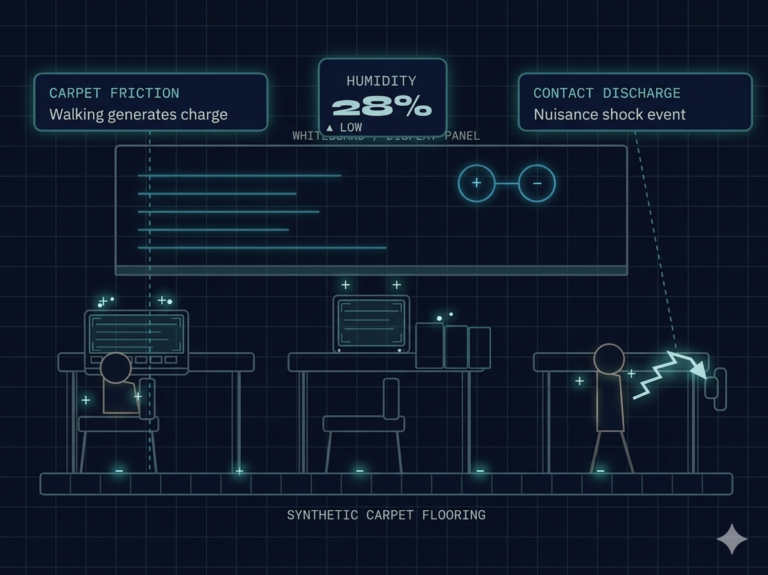
Educational environments such as classrooms, computer labs, libraries, and lecture spaces often contain a mix of synthetic materials, electronic equipment, and controlled indoor conditions, all of which can contribute to static electricity. While static in these environments is often experienced as minor shocks or nuisance behaviour, it reflects broader electrostatic interactions between materials and surroundings.
In many Australian schools and institutions, low humidity, air conditioning, and synthetic flooring or furnishings can allow static charge to build and persist. Understanding how static behaves in education settings helps explain common issues such as discomfort, dust attraction, and unexpected interactions with equipment or materials.
FUNDAMENTALS
Why Static Electricity Occurs in Education
Education environments bring together highly insulative materials, controlled indoor air conditions, and continuous human movement, a combination that creates persistent conditions for electrostatic charge generation throughout the school day. Understanding these contributing factors explains why static is experienced in classrooms, labs, libraries, and corridors alike.
Material Behaviour
Many materials commonly found in schools and learning environments are electrically insulating. When they come into contact and separate, as people move, sit, stand, or handle objects, electrons transfer between surfaces and the resulting charge persists.
- Synthetic carpets and hard plastic flooring tiles
- Plastic chairs, desk surfaces, and equipment
- Laminated surfaces and coated furniture
- Paper, books, and plastic binder covers
- Electronic device housings and screen surfaces
When materials repeatedly contact and separate, during conveyor transport or processing, electrons transfer between surfaces, generating continuous electrostatic charge.
Environmental Contributors
Environmental conditions strongly influence how static behaves in indoor education settings. Low humidity reduces the ability of surfaces to dissipate electrostatic charge — a common condition in air-conditioned or heated Australian school buildings, particularly during cooler months.
- Low humidity, especially during cooler months
- Air conditioning and heating systems drying indoor air
- Enclosed indoor spaces with limited natural airflow
- Extended climate control operation reducing ambient moisture
- Seasonal variation in humidity across Australian regions
Handling and Friction Factors
Everyday activity in education environments continuously generates static electricity. These actions create electrostatic charge through repeated contact and separation of materials, driven by the triboelectric effect across a high density of people and surfaces throughout the day.
- Walking across carpeted floors and corridors
- Sitting down and standing from chairs
- Handling books, paper, and plastic materials
- Using laptops, tablets, and shared equipment
- Moving furniture or classroom materials between sessions
Charge Generation Sequence - Education Environments
Surface Contact
Person sits, walks, or handles material
Separation Event
Person stands, lifts object, or moves through space
Charge Build-Up
Low humidity prevents passive dissipation
Charge Persists
Insulative materials retain surface charge
Discharge
Shock on door handle, desk, or equipment
RISK ASSESSMENT
Risks Associated With Static in Education
Static electricity in education environments rarely poses serious hazard, but its effects on comfort, cleanliness, and the learning environment are nonetheless real, and more persistent than many occupants recognise.
Safety Concerns
Static shocks in classrooms are usually minor but can still be noticeable and uncomfortable, particularly for students or staff frequently interacting with conductive objects such as door handles, desks, or shared equipment. While these discharges are generally harmless, they can cause surprise or distraction during learning activities.
Operational and Productivity Impact
Static electricity can affect how comfortable and functional a learning space feels. These effects may vary depending on environmental conditions, room setup, and the mix of materials in use across the space.
- Repeated static shocks when moving around the room
- Discomfort when interacting with shared equipment
- Distraction or hesitation during classroom activities
- Perceived issues with furniture, flooring, or materials
- Increased noise or complaint from sensitive occupants
Dust Attraction and Surface Contamination
Electrostatic charge on surfaces attracts dust, fibres, and airborne particles. In education environments, where surface cleanliness affects both hygiene and the condition of shared equipment, this creates compounding maintenance demands.
- Increased dust accumulation on desks and equipment surfaces
- Reduced cleanliness of shared workspaces
- More frequent cleaning requirements across the facility
- Dust build-up on screens, keyboards, and electronic devices
COMMON MISCONSEPTIONS
Myth vs Reality in Education
Two assumptions commonly encountered in education and general indoor environments can lead to an incomplete understanding of why static electricity persists in classrooms and how it is best managed.
Grounding electrical systems prevents static in classrooms
Grounding electrical systems and equipment is important for electrical safety, but it does not eliminate static electricity generated on insulating materials such as carpets, plastic surfaces, or laminated furniture. Because these materials do not conduct electricity effectively, electrostatic charge can still build up on their surfaces regardless of the quality of the facility’s electrical earthing.
Static electricity only affects specialised technical or electronics environments
Static electricity is often associated primarily with electronics and sensitive equipment. However, static behaviour affects the everyday materials found in classrooms, furniture, flooring, paper, and plastics, following the same physical principles as in any other industry. Understanding this helps explain why classrooms can experience persistent static issues without any electronics being involved.
Insulative classroom materials retain charge independently of grounding
Carpet fibres, laminated desk surfaces, and plastic chair shells accumulate electrostatic charge through normal use, and that charge resides on the material surface, not on any conductive pathway. Grounding the building’s metalwork creates no dissipation route for charge held on insulative materials in the room.
Static in education environments follows the same physical principles as in any industry
The triboelectric effect that generates charge when a student walks across carpet, or when paper is handled and set down, is the same physical mechanism at work in composites fabrication, plastic manufacturing, and mining. The consequences differ, but the underlying electrostatics are consistent. Understanding static as a material-and-environment phenomenon, not an electronics-specific one, is the starting point for meaningful analysis.
FRAMEWORK
General Categories of Static Control Approaches
Static control in education environments is conceptually organised around the same three categories that apply across other industries. The indoor nature of these environments, and the high density of people, materials, and equipment in limited spaces, shapes how each category is evaluated in practice.
01 / Environmental Control
Humidity and Airflow Awareness
Environmental conditions play a key role in static behaviour in enclosed spaces. Humidity is the most significant single variable, as indoor humidity drops, the surface resistivity of flooring, furniture, and synthetic materials increases, slowing passive charge dissipation and intensifying the static experience for occupants.
- Monitoring indoor humidity levels seasonally
- Managing ventilation and airflow patterns
- Adjusting heating and cooling system settings
- Reducing overly dry conditions in enclosed classrooms
02 / Surface Treatment Concepts
Material and Surface Approaches
Some environments use surface treatment approaches designed to influence how materials interact with electrostatic charge. In education settings, these may apply to flooring, furniture surfaces, or high-contact shared materials.
Their effectiveness depends on compatibility with cleaning and maintenance practices, durability under high-traffic conditions, and the specific materials present in the environment, all of which vary significantly between schools and institutions.
03 / Handling & Process Awareness
Space Design and Routine Awareness
Everyday activities in education environments determine much of the static electricity generated throughout the day. Understanding how static develops during routine use is often the first step toward reducing recurring issues without structural intervention.
- Material selection for flooring and furniture
- Classroom layout and typical movement patterns
- Cleaning and maintenance practices for surfaces
- Use and positioning of electronic equipment and devices
Charge Generation Sequence
Step 01
Assessment
Step 02
Strategy
Step 03
Implementation
Step 04
Monitoring
ANALYTICAL APPROACH
Understanding the Problem Before Acting
Static electricity in education environments varies depending on materials, environmental conditions, and daily activity patterns. Because of this variability, effective management typically begins with understanding the contributing factors rather than applying immediate fixes.
In schools and institutions, static problems often intensify seasonally, correlating with the use of heating or air conditioning, and may vary considerably between rooms, buildings, or campuses depending on flooring type and furnishing choices.
Environmental Monitoring
Indoor humidity and temperature profiling across different rooms and spaces, noting which areas generate the most static complaints and whether this correlates with HVAC operation or seasonal periods.
Material Identification
Characterisation of flooring type, furniture surfaces, and common materials handled in affected spaces, identifying which surfaces are most likely to be generating or retaining charge in the daily environment.
Activity Pattern Observation
Observing how people interact with the space, movement patterns, seating behaviour, shared equipment use, to identify which everyday actions are generating the most persistent electrostatic charge.
Seasonal Variation Mapping
Recording when static complaints are most frequently raised, typically during low-humidity winter periods when heating systems reduce indoor moisture, to distinguish persistent structural issues from seasonal intensification.
STATIC PROFILE DIAGNOSTIC FRAMEWORK
Environment
Humidity, temperature, season, airflow
Material
Board type, coatings, conductivity
Process Behaviour
Shock frequency, location, user patterns
Hygrometer
Surface Material ID
Human Interaction
Each variable must be independently characterised before a meaningful static risk profile can be constructed for an education facility.
About Zero Static
Understanding Static Electricity Across Australian Industry
Zero Static focuses on helping Australian industries understand how static electricity behaves across materials, environments, and operational processes. Through education and structured analysis, organisations can better identify electrostatic behaviour and make informed decisions about managing static-related conditions in everyday environments.
Explore the full authority knowledge base here