

Static Electricity in Electronics
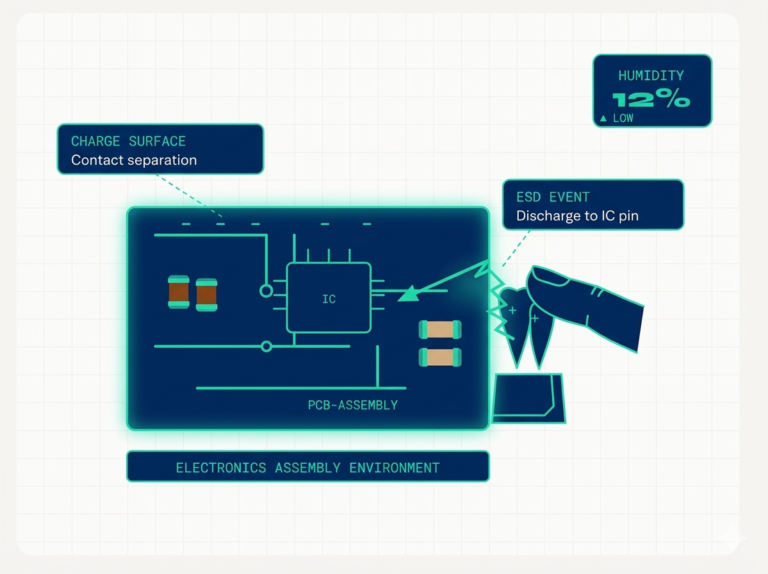
Electronic components and assemblies are among the most electrostatically sensitive materials in any manufacturing or handling environment. Charge accumulation on non-conductive surfaces, from PCB coatings and packaging films to synthetic workbench mats, creates conditions for electrostatic discharge events that are often invisible to the naked eye yet capable of degrading or destroying sensitive components.
Understanding how and why static charge develops in electronics environments is a prerequisite for any meaningful approach to electrostatic risk management.
FUNDAMENTALS
Why Static Electricity Occurs in Electronics
Electronics environments combine a high density of insulative materials with controlled, low-humidity conditions, a combination that is inherently conducive to triboelectric charge generation. Understanding the underlying contributors is essential before any control strategy can be evaluated
Material Behaviour
Many of the materials fundamental to electronics manufacturing rank among the most electrostatically active in the triboelectric series.
- PCB substrate coatings and laminates
- Plastic component trays and carriers
- Antistatic and regular packaging films
- Synthetic workbench surfaces
- Foam inserts and reel tape materials
Environmental Contributors
Controlled indoor environments designed to protect product quality often inadvertently promote static charge accumulation.
- Low relative humidity from HVAC systems
- Cleanroom air handling reduces charge dissipation
- Air conditioning reduces ambient moistur
- Filtered, low-particulate environments
- Temperature-stable conditions limit natural dissipation
Handling and Friction Factors
Physical interaction between people, surfaces, and components generates continuous triboelectric charging throughout the production cycle.
- Manual PCB handling without wrist straps
- Component removal from tape and reel
- Conveyor belt surface contact
- Sliding components in trays or carriers
- Garment friction from synthetic clothing
Charge Generation Sequence
Component Contact
PCB or part contacts an insulative surface
Charge Transfer
Electrons migrate across material boundary
Surface Separation
Low humidity prevents charge dissipation
Charge Accumulation
Static voltage builds on component surface
ESD Discharge Event
Rapid discharge through sensitive component
RISK ASSESSMENT
Risks Associated With Static in Electronics
The effects of electrostatic discharge in electronics environments range from immediately apparent failures to latent damage that degrades component reliability over time.
Safety Concerns
While ESD events in electronics rarely present a direct physical danger, micro-discharge events can create secondary risks in certain environments.
- Ignition risk near flammable solvents
- Interference with sensitive instrumentation
- Operator discomfort in high-charge environments
- Audit and compliance implications
Operational Impact
ESD is one of the most significant causes of component failure in electronics manufacturing. Its effects are not always immediately visible.
- Catastrophic component failure at point of discharge
- Latent defects causing field failure after deployment
- Degraded component reliability over product lifetime
- Increased rework rates and yield loss
- Warranty and return costs downstream
Contamination and Handling Interference
Charged surfaces in electronics environments attract particulate contamination, creating additional quality and process challenges.
- Dust attraction to PCB surfaces and open components
- Particle deposition on optical or sensor assemblies
- Contamination of solder paste or adhesive processes
- Interference with automated pick-and-place alignment
COMMON MISCONSEPTIONS
Myth vs Reality in Electronics ESD
Several widely-held assumptions about electrostatic behaviour in electronics environments are either incomplete or misleading.
If you can't feel a shock, no damage has occurred
Humans can only perceive ESD events above approximately 3,000 volts. Component damage can occur at voltages as low as 100V, well below human perception threshold.
Grounding the workbench is sufficient ESD protection
Grounding a single surface addresses only one part of the charge pathway. Personnel, tools, packaging materials, and the components themselves all require consideration.
Antistatic packaging means the component is protected indefinitely
Antistatic and shielding packaging attenuates static fields but does not eliminate them. Repeated opening, folding, and handling degrades the protective properties of packaging materials over time.
Latent damage is a significant and underestimated concern
Partial ESD damage may not cause immediate failure. A component that passes initial testing can carry a degraded junction that fails under thermal or electrical stress in the field, long after manufacture
ESD control is a system, not a single intervention
Effective ESD management requires coordinated control across personnel, environment, equipment, and process. Any single-point intervention leaves vulnerability pathways open elsewhere in the system.
Materials labelled "antistatic" behave differently to ESD-shielding materials
Antistatic materials slow charge accumulation on their own surface. ESD-shielding materials (typically metallised film) form a Faraday cage effect, protecting contents from external fields. These are distinct and not interchangeable functions.
FRAMEWORK
General Categories of Static Control Approaches
Electrostatic control in electronics environments is typically organised around three broad categories. These are conceptual orientations rather than prescriptive solutions, each must be evaluated in the context of specific operational conditions.
01 / Environmental Control
Humidity and Environmental Stability
Relative humidity is one of the most influential environmental variables in electrostatic behaviour. As ambient moisture increases, the surface resistivity of many materials decreases, facilitating passive charge dissipation. This relationship is material-dependent and non-linear.
HVAC design, humidification strategies, and airflow management all influence the electrostatic environment and must be understood before supplementary interventions are selected.
02 / Surface Treatment Concepts
Material and Surface Approaches
Material selection plays a foundational role in electrostatic management. The resistivity characteristics of workbench surfaces, flooring, garments, tooling, and packaging all contribute to the overall charge pathway within a facility.
Understanding the triboelectric properties of materials in contact with one another, and with components, provides the basis for evaluating surface treatment strategies conceptually.
03 / Handling & Process Awareness
Workstation Design and Procedures
Human interaction is the most variable element of the ESD control system. Workstation configuration, handling sequence, tool design, and process discipline all affect the degree to which charge is introduced or managed across the assembly process.
Process awareness extends to packaging handling, component transfer protocols, and the management of electrostatic discharge-sensitive device (ESDS) designations within workflows.
Charge Generation Sequence
Step 01
Assessment
Step 02
Strategy
Step 03
Implementation
Step 04
Monitoring
ANALYTICAL APPROACH
Understanding the Problem Before Acting
In electronics environments, electrostatic behaviour is rarely the result of a single factor. It emerges from the interaction of multiple variables, material properties, environmental conditions, process characteristics, and human factors, operating simultaneously.
Effective analysis requires measurement and observation before intervention. Acting on assumptions rather than measured data is one of the most common reasons ESD control programs underperform.
Environmental Measurement
Humidity, temperature, and airflow characterisation across zones within the facility, not a single-point reading.
Material Behaviour Analysis
Resistivity and charge decay characteristics of surfaces, packaging, garments, and tooling in use within the environment.
Operational Factors
Process sequence, handling frequency, personnel movement patterns, and the sensitivity classification of components being handled.
Facility and Infrastructure Review
Grounding and bonding infrastructure, flooring resistivity, equipment connectivity, the physical charge pathway through the facility.
STATIC PROFILE DIAGNOSTIC FRAMEWORK
Environment
Humidity, temperature, season, airflow
Material
Board type, coatings, conductivity
Behaviour
Shock frequency, location, user patterns
Hygrometer
Surface Material ID
Human Interaction
Each variable must be independently characterised before a meaningful risk profile can be constructed.
About Zero Static
Understanding Static Electricity Across Australian Industry
Zero Static helps Australian industries understand how static electricity behaves across materials and environments. Our focus is on providing technically grounded, evidence-based information that supports informed decision-making, without prescribing specific products or solutions.
The Electronics industry page is part of a broader knowledge resource covering static behaviour across manufacturing, infrastructure, and facility environments throughout Australia.
Explore the full authority knowledge base here