

Static Electricity in Plastic Mining
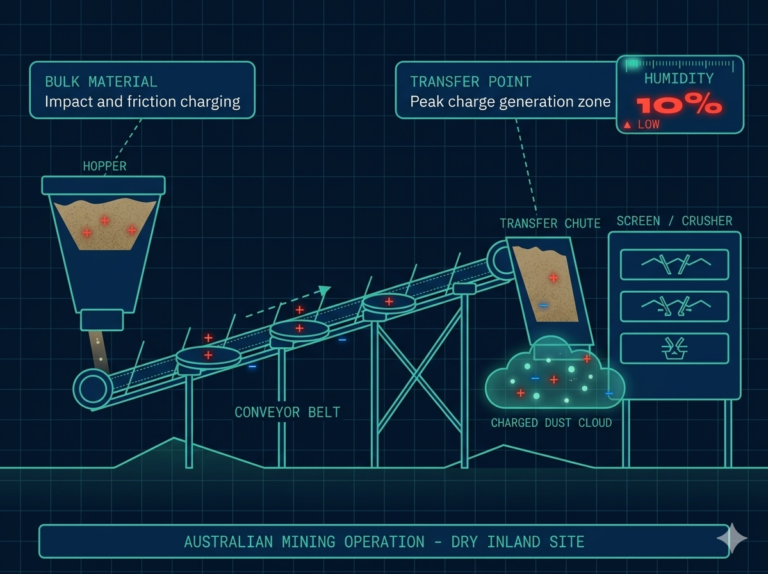
Mining environments combine dry conditions, large material movement, and constant interaction between equipment, surfaces, and particulate matter — all of which contribute to static electricity generation. From bulk material handling to conveyor systems and processing plants, electrostatic charge can develop continuously during normal operations.
In many Australian mining regions, low humidity, dust, and temperature variation create conditions where static electricity can persist and accumulate. Understanding how static behaves in mining environments helps explain issues such as nuisance shocks, dust attraction, material handling interference, and potential ignition risks in specific conditions.
FUNDAMENTALS
Why Static Electricity Occurs in Mining
Mining environments present a combination of dry conditions, continuous large-scale material movement, and extensive use of insulative surfaces, making electrostatic charge generation a persistent feature of normal operations. Understanding the contributing factors is the first step in managing static behaviour across mining sites.
Material Behaviour
Mining operations involve a wide range of materials, many of which generate or retain electrostatic charge. While some may be partially conductive, many surfaces in mining operations behave as insulators, allowing static to accumulate during continuous movement and contact.
- Conveyor belts (rubber and synthetic compounds)
- Plastic chute liners and wear surfaces
- Bulk materials - coal, ore, aggregates, and minerals
- Polymer protective coatings on equipment
- Packaging materials used in processing or transport
When materials repeatedly contact and separate, during conveyor transport or processing, electrons transfer between surfaces, generating continuous electrostatic charge.
Environmental Contributors
Environmental conditions play a significant role in how static electricity develops and persists in mining environments. Low humidity reduces natural charge dissipation, allowing static to remain on surfaces for extended periods. Dust and fine particles can also become electrically charged, further influencing electrostatic behaviour across the site.
- Low humidity - particularly in inland Australian regions
- Dry, dusty ambient air across open-cut operations
- High daytime temperatures reducing relative humidity
- Wind exposure at surface operations
- Enclosed processing facilities with recirculated airflow
Handling and Friction Factors
Mining operations involve continuous material movement, making static generation a persistent feature of the operational environment. These activities generate electrostatic charge through repeated friction, impact, and separation of materials, particularly in dry conditions.
- Bulk material transport on long-distance conveyor systems
- Material transfer between chutes, hoppers, and bins
- Crushing, screening, and classification operations
- Vehicle and mobile equipment movement over dry surfaces
- Interaction between material streams and equipment surfaces
Charge Generation Sequence - Mining Operations
Surface Contact
Bulk material contacts belt, liner, or chute
Friction and Impact
Material moves, crushes, or transfers between systems
Charge Build-Up
Low humidity prevents passive dissipation
Dust Charging
Airborne particles acquire charge from surfaces
Discharge or Attraction
Shock, sticking, or dust accumulation
RISK ASSESSMENT
Risks Associated With Static in Mining
The scale and nature of mining operations, large material volumes, extended conveyor runs, dusty environments, and the presence of combustible materials in some contexts, give static electricity a broader risk profile than in many other industries.
Safety Concerns
Static discharges are often small, but in certain mining environments, particularly where flammable gases, vapours, or combustible fine dust are present, electrostatic discharge can contribute to ignition risk. Even where ignition risk is low, nuisance shocks affect worker comfort and situational awareness during routine tasks.
Operational and Productivity Impact
Static electricity can influence how materials move and behave within mining systems, affecting consistency and efficiency in processing operations, often intensifying during dry seasonal conditions.
- Material sticking within chutes, hoppers, or conveyors
- Uneven or disrupted material flow through systems
- Build-up on equipment surfaces and screens
- Interference with automated sensors or level detection
- Reduced throughput consistency during dry periods
Dust Attraction and Surface Contamination
Static charge attracts and holds fine dust particles on equipment surfaces. In mining environments, where dust generation is continuous, the interaction between charged surfaces and airborne particulate creates compounding maintenance and visibility challenges.
- Increased dust accumulation on equipment and sensors
- Reduced visibility of surface markings and indicators
- Additional cleaning and maintenance requirements
- Changed dust behaviour within enclosed processing areas
- Dust re-entrainment from charged surfaces after settlement
COMMON MISCONSEPTIONS
Myth vs Reality in mining
Two assumptions frequently encountered in mining and heavy industry contexts can lead to incomplete understanding of where static electricity originates and how it persists in operational environments.
Grounding equipment eliminates static from insulating surfaces
Grounding equipment is essential for electrical safety, but it does not eliminate static electricity generated on insulating materials such as conveyor belts, plastic liners, or bulk materials in transport. Because many surfaces in mining operations are not highly conductive, electrostatic charge can still accumulate even when all metal structures are grounded.
Static electricity only affects precision electronics and clean environments
Static electricity is often associated primarily with electronics and ESD-sensitive environments. However, mining demonstrates that static behaviour also affects large-scale industrial processes, bulk materials, and open environmental conditions, sometimes at significantly higher charge magnitudes than in controlled manufacturing settings.
Insulative bulk materials retain charge independently of grounded structures
Charge generated on rubber conveyor belts, polymer chute liners, and bulk material streams resides on those insulative surfaces, not on surrounding metalwork. Grounding the steel structure provides no dissipation pathway for charge held on non-conductive material surfaces, regardless of how thoroughly the infrastructure is bonded.
Mining environments often produce very high electrostatic charge levels
Understanding the distinction between ESD control and general industrial static management helps explain issues such as dust movement, material sticking in transfer chutes, and unexpected discharge events in processing areas, phenomena that ESD-focused frameworks are not designed to address at the scale seen in mining.
FRAMEWORK
General Categories of Static Control Approaches
Static control in mining environments requires approaches suited to the scale of operations, the materials involved, and the environmental conditions typical of Australian mining sites. The same three conceptual categories apply as in other industries, but the operational context of mining shapes how each is evaluated and implemented.
01 / Environmental Control
Humidity and Airflow Awareness
Environmental factors influence static accumulation across both open-cut and enclosed processing areas. In Australian mining, the combination of low ambient humidity and high dust generation creates conditions where environmental management plays a substantial role in determining the severity of static behaviour.
- Monitoring humidity levels across site zones
- Managing airflow in enclosed processing facilities
- Controlling dust generation and movement at transfer points
- Accounting for temperature and seasonal variation
02 / Surface Treatment Concepts
Material and Surface Approaches
Some mining environments apply surface treatment concepts designed to influence how materials and equipment interact with electrostatic charge. These approaches vary depending on material type, operational requirements, and site-specific environmental conditions.
Effectiveness depends on maintenance schedules, material compatibility, long-term environmental exposure, and the abrasive conditions typical of bulk material handling, which can degrade surface treatments at a higher rate than in cleaner environments.
03 / Handling & Process Awareness
Operational Design and Workflow
The design and operation of conveyor systems, transfer chutes, and processing equipment largely determines where and how static electricity is generated across a site. Understanding these generation points is often the first step toward reducing operational impact.
- Conveyor design, speed, and material interaction
- Transfer point geometry and drop height
- Equipment layout in processing facilities
- Material flow behaviour through chutes and bins
- Maintenance and cleaning processes for charged surfaces
Charge Generation Sequence
Step 01
Assessment
Step 02
Strategy
Step 03
Implementation
Step 04
Monitoring
ANALYTICAL APPROACH
Understanding the Problem Before Acting
Static electricity in mining environments varies depending on material type, environmental conditions, and the specifics of operational processes. Because of this variability, effective static management usually begins with structured assessment rather than immediate intervention.
The scale and complexity of mining operations, spanning multiple material types, kilometres of conveyor, and highly variable weather conditions, make site-specific assessment particularly important before any control approach is selected.
Environmental Measurement
Humidity and temperature profiling across the site, open-cut areas, enclosed processing facilities, and transfer stations, including seasonal and diurnal variation patterns.
Material Identification
Characterisation of the specific materials involved in processing and transport — including the triboelectric properties of conveyor belt compounds, liner materials, and bulk commodity types.al Identification
Seasonal and Site-Specific Variation
Systematic observation of how materials move through conveyor systems, transfer chutes, and processing equipment, identifying where charge generation, accumulation, or discharge events are most consistently observed.
Seasonal and Site-Specific Variation
Recording when static-related problems are most frequently reported, typically correlating with peak low-humidity periods in inland Australian regions, to distinguish persistent structural issues from seasonal intensification.
STATIC PROFILE DIAGNOSTIC FRAMEWORK
Environment
Humidity, temperature, season, airflow
Material
Board type, coatings, conductivity
Behaviour
Shock frequency, location, user patterns
Hygrometer
Surface Material ID
Human Interaction
Each variable must be independently characterised before a meaningful static risk profile can be constructed for a mining operation.
About Zero Static
Understanding Static Electricity Across Australian Industry
Zero Static focuses on helping Australian industries understand how static electricity behaves across materials, environments, and operational processes. Through education and structured analysis, organisations can better identify electrostatic behaviour and make informed decisions about managing static-related challenges in complex industrial environments.
Explore the full authority knowledge base here