

Static Electricity in Plastic Manufacturing
Plastic manufacturing environments are especially prone to static electricity because many plastics are highly insulative and are constantly moving, separating, cutting, moulding, or conveying during production. As a result, electrostatic charge can build quickly on materials, machinery surfaces, packaging, and finished products.
In Australia’s often dry industrial conditions, static behaviour in plastic manufacturing can become more noticeable during handling, extrusion, thermoforming, injection moulding, film production, and post-processing. Understanding how static develops in these environments helps explain issues such as dust attraction, material sticking, handling interference, and inconsistent production behaviour.
FUNDAMENTALS
Why Static Electricity Occurs in Plastic Manufacturing
Plastic manufacturing brings together highly insulative materials and high-speed continuous processes, a combination that makes electrostatic charge generation both inevitable and persistent. The properties of the polymers themselves are the primary driver, but environmental and process factors determine how charge accumulates and behaves across the production line.
Material Behaviour
Most plastics used in manufacturing are electrically insulating, which means they generate and retain electrostatic charge rather than dissipate it. When these materials contact other surfaces and then separate, electrons transfer between them and the charge persists on the surface.
- Polyethylene (PE) - film, sheet, and moulded parts
- Polypropylene (PP) - packaging and components
- PVC - pipe, sheet, and profile extrusions
- PET - film, bottle, and fibre applications
- ABS and acrylic, moulded and formed products
- Engineered polymer blends and composites
Environmental Contributors
Environmental conditions strongly affect how static behaves in plastic manufacturing facilities. When humidity is low, static charge tends to persist for longer because surfaces become less conductive and passive dissipation slows significantly.
- Low indoor humidity in enclosed production spaces
- Warm production environments that reduce ambient moisture
- Dry seasonal conditions across Australian regions
- Ventilation and airflow systems altering local conditions
- Airborne dust or fine plastic particles in circulation
Handling and Friction Factors
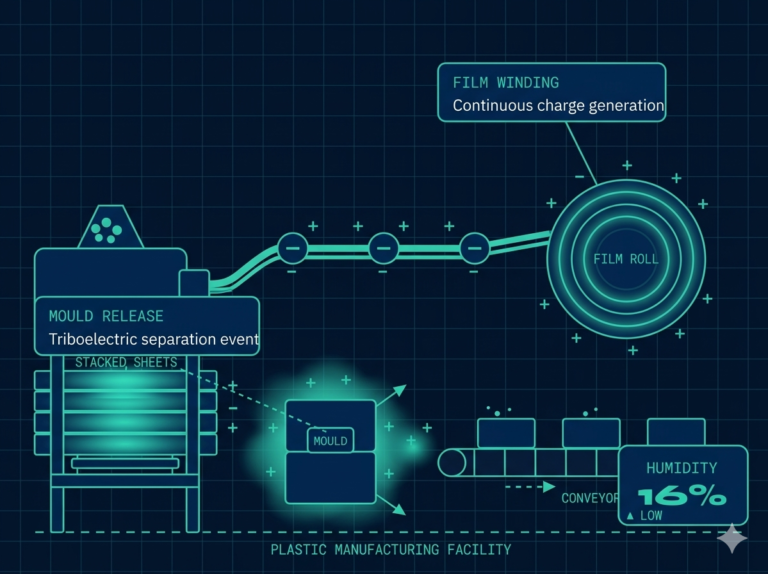
Plastic manufacturing processes generate repeated contact and separation events — making static electricity a persistent issue across many operations. These activities create charge through the triboelectric effect, particularly where plastic surfaces rub, separate, or move at speed.
- Film winding, unwinding, and slitting operations
- Conveyor movement of plastic parts and sheet
- Injection mould release and part ejection
- Thermoformed part handling and stacking
- Cutting, trimming, or routing plastic profiles
- Bagging and packaging of finished goods
Charge Generation Sequence - Plastic Manufacturing
Surface Contact
Plastic contacts roller, mould, or adjacent film
Electron Transfer
Triboelectric charge migrates at interface
Separation Event
Film unwind, part release, or sheet separation
Charge Retained
Low humidity retains charge on plastic surface
Discharge or Attraction
Shock, film cling, or dust contamination
RISK ASSESSMENT
Risks Associated With Static in Plastic Manufacturing
Static charge in plastic manufacturing creates risks across safety, production quality, and operational efficiency, with effects that often intensify under dry conditions or at higher process speeds.
Safety Concerns
Static discharges in plastic manufacturing environments are often minor, but they can still produce nuisance shocks when operators touch grounded equipment or nearby conductive structures. In some situations, especially where vapours, powders, or fine airborne particles are present, electrostatic discharge may also increase ignition concern.
- Spark ignition risk near flammable solvents
- Operator shock or startle during film removal
- Nuisance discharges reducing operator confidence
- Increased risk in enclosed or poorly ventilated areas
Operational and Productivity Impact
Static electricity can interfere with normal manufacturing flow in several ways, becoming more noticeable under dry conditions or during higher-speed processing runs.
- Plastic film clinging to rollers or finished products
- Sheets sticking together during stacking or separation
- Parts behaving unpredictably after mould release
- Handling disruptions during transfer or packaging
- Inconsistent feed or separation on automated lines
Dust Attraction and Surface Contamination
Charged plastic surfaces attract dust, fibres, and fine airborne contaminants. In manufacturing environments, even minor contamination can affect surface appearance, downstream processing, or customer perception of finished goods.
- Surface contamination before packaging or dispatch
- Visible finish defects on moulded or extruded surfaces
- Increased cleaning requirements across production areas
- Reduced presentation or quality consistency in finished products
COMMON MISCONSEPTIONS
Myth vs Reality in Plastic Manufacturing
Two assumptions about static electricity are frequently encountered in plastic manufacturing contexts, and both can lead to incomplete or ineffective responses to recurring electrostatic problems.
Grounding machinery eliminates static from plastic materials
Grounding machines, rollers, or structural equipment is important, but it does not automatically remove static charge from insulating plastic materials. Because many plastics do not conduct electricity easily, charge can remain on the material surface even when surrounding equipment is fully grounded.
Static electricity only matters in electronics manufacturing
Static electricity is often associated mainly with electronics and ESD-sensitive components. However, plastic manufacturing is one of the most common environments where broader static behaviour appears, through dust attraction, sticking, handling difficulty, and process inconsistency, without a single electronic component in sight.
Charge on insulative plastic surfaces requires approaches suited to insulators
Unlike conductive materials, insulative plastics cannot discharge through grounding pathways. The charge resides on the material surface and persists until environmental conditions support passive dissipation, or until an active intervention acts on the surface itself rather than on surrounding metalwork.
Plastic manufacturing exhibits some of the most intense static environments in any industry
Understanding the difference between ESD control and general static behaviour helps clarify why plastics require a broader electrostatic perspective. The triboelectric effect operates continuously and at high intensity in many plastic processing operations, producing charge levels far in excess of what ESD-focused approaches are designed to address.
FRAMEWORK
General Categories of Static Control Approaches
Static control in plastic manufacturing is conceptually organised around three categories. Each must be evaluated against the specific polymers, process speeds, environmental conditions, and production demands of the facility in question, there is no universal approach that applies uniformly across all plastic manufacturing contexts.
01 / Environmental Control
Humidity and Airflow Awareness
Environmental conditions can strongly influence how electrostatic charge is retained across plastic surfaces and processing equipment. Humidity is the most significant single environmental variable, as relative humidity increases, the surface conductivity of many polymers improves and passive charge dissipation accelerates.
- Monitoring relative humidity across production zones
- Managing airflow around high-speed film and extrusion lines
- Reducing airborne dust near sensitive surfaces
- Stabilising temperature where practical
02 / Surface Treatment Concepts
Material and Surface Approaches
Some manufacturing environments use surface treatment concepts to influence how plastic materials interact with electrostatic charge. These may include temporary approaches or longer-term material-compatible strategies depending on the process type and product requirements.
Effectiveness depends on maintenance requirements, material compatibility, environmental conditions during production, and the speed and nature of the processes involved.
03 / Handling & Process Awareness
Workstation Design and Workflow
Operational processes frequently determine how much static electricity is generated, and at which points in the production line charge accumulates most significantly. Recognising these generation points is often the first step toward reducing persistent issues.
- Material speed and surface contact points
- Packaging methods and film handling sequences
- Part transfer, stacking, and alignment behaviour
- Equipment layout relative to charge-sensitive operations
Charge Generation Sequence
Step 01
Assessment
Step 02
Strategy
Step 03
Implementation
Step 04
Monitoring
ANALYTICAL APPROACH
Understanding the Problem Before Acting
Static electricity in plastic manufacturing varies depending on material type, process speed, environmental conditions, and handling methods. Because of this, effective static management usually begins with structured assessment rather than immediate treatment.
Acting without measurement data, particularly in high-speed or high-volume manufacturing contexts, risks misidentifying the source or nature of the static problem, resulting in interventions that address symptoms rather than causes.
Environmental Measurement
Humidity and temperature profiling across the production facility, at film lines, moulding stations, stacking areas, and packaging zones, not a single representative reading.
Polymer Identification
Characterisation of the specific polymers involved and their triboelectric position relative to the surfaces, rollers, and tooling they contact throughout the production cycle.
Production Line Observation
Systematic mapping of where charge visibly develops, or where problems such as film cling, part sticking, or dust attraction occur, in relation to specific process steps.
Seasonal and Batch Variation
Recording when static problems intensify, often corresponding with seasonal humidity drops, changes in raw material batches, or shifts in production speed or volume.
STATIC PROFILE DIAGNOSTIC FRAMEWORK
Environment
Humidity, temperature, season, airflow
Material
Board type, coatings, conductivity
Behaviour
Shock frequency, location, user patterns
Hygrometer
Surface Material ID
Human Interaction
Each variable must be independently characterised before a meaningful static risk profile can be constructed for a plastic manufacturing environment.
About Zero Static
Understanding Static Electricity Across Australian Industry
Zero Static focuses on helping Australian industries understand how static electricity behaves across materials, environments, and operational processes. Through education and structured analysis, organisations can better identify electrostatic behaviour and make more informed decisions about managing static-related issues in manufacturing environments.
The Warehouse & Logistics industry page is part of a broader knowledge resource covering static behaviour across manufacturing, fabrication, and infrastructure environments throughout Australia..
Explore the full authority knowledge base here